
.png?width=1200&height=675&name=Silver%20Bullion%20(2).png)
Silver Supply
Market Insights
Precious Metals History
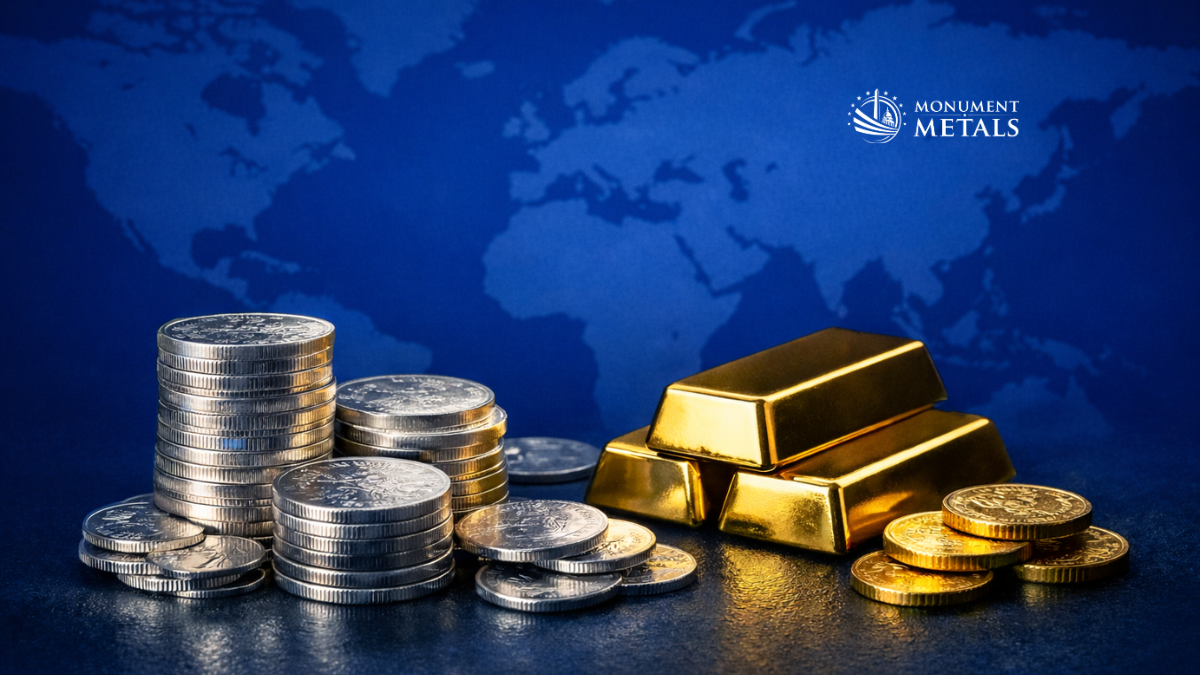

When global tensions rise, precious metals often get attention.
Conflicts, sanctions, trade disputes, and political uncertainty can all influence gold and silver prices. This reaction isn’t new. For centuries, investors have turned to precious metals during periods of instability because of their role as a tangible store of value.
Understanding how geopolitics affects the metals market helps you look beyond headlines and recognize what’s driving price movements.
Gold and silver are not tied to any single government, currency, or economy. Their value comes from their metal content and global market pricing, not from policy decisions or financial system performance.
When confidence in financial markets, currencies, or institutions starts to weaken, some investors shift toward physical assets. Precious metals carry no counterparty risk. They are not someone else’s liability, and their value cannot be reduced by monetary policy or default.
This independence is one of the reasons geopolitical uncertainty often increases interest in physical metals.
Not every headline moves prices, but certain developments tend to matter more.
Armed conflict and military escalation
Sudden instability raises concerns about economic disruption and global risk. Investors often move toward safety, which can support gold.
Economic sanctions and financial restrictions
When access to global payment systems or trade networks is disrupted, assets outside the financial system become more attractive.
Political transitions and major elections
Uncertain policy direction, currency risk, or fiscal concerns can influence investor behavior.
Trade tensions between major economies
Concerns about global growth and supply chains can indirectly affect precious metals demand.
The common factor is uncertainty. When stability and predictability come into question, interest in gold and silver tends to increase.
.png?width=305&height=305&name=1kg-gold-bar-9999-fine-gold-us-dollar-background%20(2).png)
Gold is widely viewed as a safe-haven asset. During periods of geopolitical stress, risk assets such as equities may decline, and investors often shift toward preservation rather than growth.
The response isn’t always immediate or consistent. A stronger U.S. dollar during global stress can limit gold’s upside, and short-term spikes sometimes reverse as events develop.
However, during extended periods of uncertainty, gold has historically found support. Each time it performs during market stress, its reputation as a stabilizing asset is reinforced.
Central banks hold gold as a strategic reserve, and their activity has become an important source of demand.
In recent years, many central banks have increased gold holdings. Some are diversifying away from dollar-denominated assets. Others are responding to concerns about financial system access and sanctions risk.
Unlike short-term trading activity, central bank buying is typically steady and long-term. This institutional demand helps provide a foundation for the gold market during periods of uncertainty.
Markets do not react to every headline.
Events are more likely to influence prices when they:
A brief incident may cause a short-lived spike. Prolonged geopolitical tension is more likely to provide sustained support for precious metals.
Over time, markets also adjust. Once investors become accustomed to a particular type of risk, price reactions may become more muted.
For long-term buyers, geopolitical events should be viewed as background conditions, not trading signals.
Trying to predict which headline will move prices is difficult and often leads to buying after the market has already reacted.
A more practical approach is to build a position over time. Consistent accumulation means you already own physical metals when uncertainty increases, rather than trying to enter the market during periods of elevated demand.
Some buyers add more during calmer markets when premiums may be lower. Others maintain a steady purchase strategy regardless of conditions. Both approaches recognize that geopolitical risk is ongoing, not occasional.
Geopolitical events influence precious metals because uncertainty changes investor behavior. Conflict, sanctions, political instability, and trade tension all increase the appeal of tangible assets.
Short-term price moves are unpredictable, and not every event leads to lasting changes. But over longer periods, global uncertainty has consistently supported the role of gold and silver as long-term stores of value.
Building a position before uncertainty peaks puts you in a stronger position than reacting after the fact.
Explore gold and silver at Monument Metals and build your position with confidence.
.png?width=1170&height=172&name=2026_1_oz_AGB_-_Website_Banner_1%20(1).png)
%20copy.webp?width=1200&height=675&name=What%20Is%20the%20Difference%20Between%20a%20Coin%E2%80%99s%20Mintage%20and%20Its%20Available%20Supply%20%20(1)%20copy.webp)