
.png?width=1200&height=675&name=Silver%20Bullion%20(2).png)
Silver Supply
Market Insights
Precious Metals History
.png?width=1200&height=675&name=Morgan%20Banner%20(2).png)

The Morgan dollar is one of the most collected coins in the world. That status comes from more than a century of steady demand, with generations of buyers continuing to come back to it. Over time, it has built a level of recognition and liquidity that few coins can match.
Part of the appeal is the silver. Every Morgan contains nearly three-quarters of a troy ounce of the metal, which gives even the most worn examples real tangible value. But the bigger draw is everything else: the history, the range of dates and mintmarks, the story of where they came from and how many survived. That's what keeps collectors coming back.
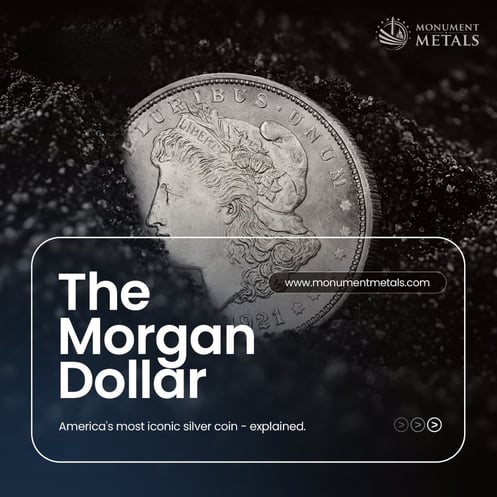
The Morgan dollar was born out of politics as much as commerce. In 1878, Congress passed the Bland-Allison Act, requiring the U.S. Treasury to purchase silver from American mines and coin it into dollars.
George T. Morgan, a British-born engraver at the U.S. Mint, was chosen to design the coin. He based his portrait of Liberty on Anna Willess Williams, a schoolteacher from Philadelphia.
The coins were struck from 1878 through 1904, then again briefly in 1921 before giving way to the Peace dollar design.
In 1918, the U.S. government passed the Pittman Act, authorizing the melting of silver dollars to address a wartime shortage. Approximately 270 million Morgan dollars were destroyed. When you factor in everything lost or worn beyond recognition over 150 years, fewer than 15% of all Morgans ever struck are estimated to still exist. That permanent reduction in supply is part of why even common-date coins carry a premium above their silver content.
Every Morgan dollar is 90% silver and 10% copper, containing 0.7734 troy ounces of pure silver. That silver content creates a price floor. Even a heavily worn Morgan with no collector appeal is worth something based on the metal alone. Dealers call these "cull" coins, and they're popular with buyers who want historic silver close to melt value.
Morgan dollars also hold nearly three times the silver of a 90% quarter, which appeals to stackers who want to accumulate weight without counting through large quantities of smaller pieces.
Morgan dollars were struck at five facilities: Philadelphia (no mintmark), Carson City (CC), San Francisco (S), New Orleans (O), and Denver (D). Each mint produced different quantities in different years, which is why the mintmark is one of the first things buyers and collectors look at.
Carson City coins carry the strongest collector premium. The CC Mint operated from 1870 to 1893 in the heart of the Nevada silver boom, producing coins in smaller quantities than the larger eastern facilities. That combination of western history and limited supply has driven demand for CC-marked Morgans for decades.
To find the mintmark, flip the coin over and look just above the "DO" in "DOLLAR," beneath the eagle's tail feathers.
Some years were produced in massive quantities and trade close to silver value. Others were struck in small numbers and command significant premiums. The 1921 Philadelphia, for example, saw tens of millions of coins produced and is the most common date in the series. The 1893-S, with only 100,000 struck, is the rarest regular-issue Morgan and one of the most sought-after coins in American numismatics.
For most buyers starting out, common-date circulated Morgans in the $35 to $50 range are a natural entry point. They give you real silver, a piece of history, and a feel for the series before moving into higher-premium territory.
Morgan dollars work on two different levels depending on what you're looking for.
If your goal is accumulating silver, common-date and cull Morgans trade close to spot and carry strong dealer recognition. They're a practical way to stack historic 90% silver without paying up for condition or rarity.
If collecting is the draw, the Morgan dollar series offers one of the deepest rabbit holes in American coinage. Between dates, mintmarks, varieties, and grade levels, serious collectors can spend years building a meaningful set. Professional grading by PCGS or NGC matters more as you move into better dates, since condition has a major impact on value at that level.
Both approaches are valid. The coin works either way, which is part of why it's held up as the world's most collected coin for as long as it has.
Buy from reputable dealers, especially for anything priced above silver value. Counterfeits exist, particularly for high-value dates, and certified coins from PCGS or NGC eliminate that risk.
Never clean a Morgan dollar. Cleaning destroys the natural surface and can reduce a coin's value significantly. Even dark or heavily toned examples should be left alone. Original surfaces, in any condition, are always preferred.
Know what you're paying for. A common-date Morgan at $40 is essentially a silver purchase. A key date at several hundred dollars is a collectible purchase. Both make sense in the right context.
How much silver is in a Morgan dollar? Each Morgan dollar contains 0.7734 troy ounces of pure silver in a 90% silver, 10% copper alloy. That silver content gives every example a baseline value tied to the current spot price of silver, regardless of its collector grade.
What does the mintmark on a Morgan dollar mean? The mintmark identifies which U.S. Mint facility struck the coin. A small letter above "DO" on the reverse tells you the origin: CC for Carson City, S for San Francisco, O for New Orleans, D for Denver. No letter means Philadelphia. The mintmark matters because different mints produced different quantities, which directly affects rarity and value.
What is the most valuable Morgan dollar? The 1895 Philadelphia Morgan is the rarest in the series, with only approximately 880 proof coins known to exist. For regular-issue coins, the 1893-S with just 100,000 struck is the standout key date, with top-grade examples selling at auction for hundreds of thousands of dollars.
Should I clean my Morgan dollar before selling it? No. Never clean a Morgan dollar. Cleaning removes the natural surface and can reduce a coin's value by 30% to 70% or more. Dealers and collectors strongly prefer original, uncleaned surfaces in any condition.
What is a cull Morgan dollar? A cull is a Morgan in heavily worn or damaged condition with no meaningful collector value beyond its silver content. Culls typically trade at or near melt value and are popular with buyers who want historic 90% silver without paying a condition premium.
.png?width=1170&height=172&name=2026_1_oz_AGB_-_Website_Banner_1%20(1).png)
%20copy.webp?width=1200&height=675&name=What%20Is%20the%20Difference%20Between%20a%20Coin%E2%80%99s%20Mintage%20and%20Its%20Available%20Supply%20%20(1)%20copy.webp)