
.png?width=1200&height=675&name=Silver%20Bullion%20(2).png)
Silver Supply
Market Insights
Precious Metals History
%20(11)-1.png?width=1200&height=675&name=NO%20TEXT%20Official%20Blog%20Banners%20(1200%20x%20675%20px)%20(11)-1.png)

A coin starts as a flat, featureless metal disc and comes out of a press with a portrait, an eagle, a date, and a perfectly formed edge, all in a fraction of a second.
What happens in between involves heat, precision tooling, and pressure measured in hundreds of tons. The process is fast, exacting, and has been refined over centuries to produce a product that's consistent enough to trade anywhere in the world.
.png?width=308&height=308&name=STOCK%20VAULT%20(43).png)
Before any pressing happens, the metal has to be prepared. Mints receive large coils of metal alloy, already rolled to the correct thickness for a given coin. A blanking press punches circular discs out of the strip, much like a cookie cutter moving at high speed. These discs are called blanks, or planchets, and at this stage they're uniform circles of metal with no design, no rim, and no distinguishing features beyond their diameter and weight.
The leftover strip after blanking is recycled back into the system. Nothing is wasted.
Fresh blanks are too hard and brittle to strike cleanly. Before they reach the coin press, they go through an annealing furnace, where they're heated to temperatures up to 1,600 degrees Fahrenheit in an oxygen-free environment. The heat relieves internal stress in the metal and makes it more workable.
From the furnace, the blanks are dropped into a quench tank filled with water mixed with citric acid and lubricants. The rapid cooling locks in the softened state while keeping the blanks from sticking together. They come out clean, slightly softened, and ready for the next step.
Before a blank ever sees a die, it passes through an upsetting mill. This machine feeds blanks into a groove that's slightly narrower than the disc's diameter. As the blank moves through, the pressure forces metal upward around the outer edge, creating a raised rim.
That rim matters more than it looks. It protects the coin's design from wear during circulation, helps center the blank correctly in the press, and contributes to the coin's final diameter. Without upsetting, coins would strike unevenly and wear down much faster in use.
The heart of the coin press is the dies. Two of them, one for the obverse and one for the reverse, each carrying a mirror image of the coin's final design carved in relief. The design is sunken into the die, so when pressure forces metal against it, the metal flows into the recessed areas and the design appears raised on the coin.
.png?width=361&height=361&name=STOCK%20VAULT%20(44).png)
Dies are made from hardened steel and are engineered to withstand millions of strikes. They're produced through a multi-step process starting with an artist's original model, which is reduced to scale and transferred to a master hub, then to working dies that go into the press. Every detail on every coin struck from a given die traces back to the same original design.
Surrounding the blank in the press is a third component most people don't think about: the collar. It's a ring-shaped die that holds the blank in place during striking and forms the coin's edge. Smooth-edged coins use a plain collar. The reeded edge on a dime or quarter comes from a reeded collar that impresses those parallel lines during the same strike that creates the obverse and reverse design.
.png?width=316&height=316&name=STOCK%20VAULT%20(45).png)
When the blank is seated between the dies, the press drives the upper die downward with enormous force. The entire strike takes a fraction of a second. The metal doesn't melt or deform in the way heating would cause. Instead, it cold flows, meaning it moves and redistributes at a molecular level under the pressure, filling the recessed areas of both dies simultaneously. When the dies separate, the blank has become a coin.
The force required to strike a coin is far beyond anything in everyday experience. Standard circulating coin presses operate at between 35 and 100 metric tons of pressure depending on the denomination and size. Larger coins require more. The U.S. Mint's five-ounce silver coins are struck at up to 540 metric tons of pressure.
For context, a typical car weighs roughly two metric tons. A single strike from a large coin press applies the equivalent weight of 270 cars in a fraction of a second.
The concept of cold flow is what makes coin striking work. The metal doesn't melt. It moves. Under that pressure, the crystalline structure of the metal shifts to fill the die's recessed design areas completely. The result is a coin with crisp, fully rendered detail that reflects exactly what the die contains.
If a blank is too hard, the metal won't flow fully and the coin comes out weakly struck with soft or incomplete detail. That's why annealing matters. A properly prepared blank cold flows predictably, and the coin looks exactly as the die intended.
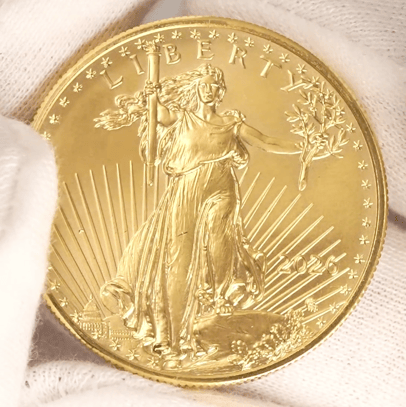
When a mint produces bullion coins for the open market, the priority is volume. Blanks are fed automatically into high-speed presses, struck once under standard pressure, and dropped into bins. A circulating coin press can produce 750 coins per minute. Silver bullion coin presses run at up to 3,000 coins per hour.
The result is a well-made, accurately struck coin with strong detail and consistent weight. It's not hand-finished, but it doesn't need to be. A silver coin or gold coin struck this way holds its design well, photographs cleanly, and trades exactly as it should.
Proof coins follow a fundamentally different path. The blanks are polished before striking. The dies are specially prepared with mirror-polished fields and frosted design elements, and they're cleaned with air between each coin to prevent any contamination from affecting the surface.
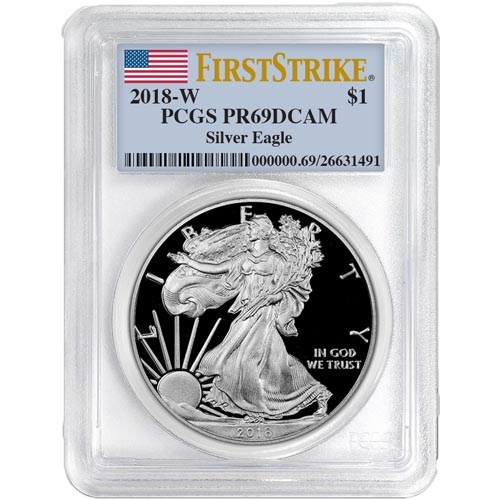
Each blank is loaded into the press by hand. The coin is struck multiple times, sometimes up to six, at higher pressure than standard bullion. The multiple strikes force metal into every detail of the die with exceptional completeness. The result is the deep mirror fields and sharp frosted design contrast that proof coins are known for.
The tradeoff is speed. Where a bullion press runs hundreds of coins per minute, a proof press handles a small number of individually tended coins per hour.
A properly struck coin has fully rendered details throughout the design, no soft or mushy areas, a clean flat field around the devices, and a uniform rim. Weakly struck coins show flat or incomplete detail, particularly on the high points of the design, where metal has to travel the farthest to fill the die.
For bullion buyers, strike quality is a baseline expectation. For collectors, particularly of older coins where press technology was less consistent, strike quality is one of the factors that separates ordinary examples from exceptional ones.
Understanding how a coin is made puts its value in clearer context. The difference in process between a standard bullion coin and a proof coin explains why proofs carry higher premiums. The handwork, the multiple strikes, the special dies, and the individual inspection all represent real additional labor and care.
For buyers focused on metal content, a single-struck bullion coin delivers exactly what it promises. For buyers who want the finest possible example of a design, the proof process exists specifically to produce that result.
%20Direction%20Clean%2c%20embedded%2c%20value-driven%20%E2%80%94%20with%20subtle%20Monument%20branding%20that%20doesn%E2%80%99t%20scream%20%E2%80%9Cad%E2%80%9D%20%E2%9C%8D%EF%B8%8F%20Locked%20Language%20(Option%202%20Refined)%20Primary%20(Hero)%20Shop%20What.png?width=1170&height=300&name=%F0%9F%8E%AF%20Final%20Banner%20Concept%20(1170%20%C3%97%20172)%20Direction%20Clean%2c%20embedded%2c%20value-driven%20%E2%80%94%20with%20subtle%20Monument%20branding%20that%20doesn%E2%80%99t%20scream%20%E2%80%9Cad%E2%80%9D%20%E2%9C%8D%EF%B8%8F%20Locked%20Language%20(Option%202%20Refined)%20Primary%20(Hero)%20Shop%20What.png)
What is a planchet? A planchet is the blank metal disc that gets struck in a coin press to become a coin. It starts as a featureless circle punched from a metal strip, goes through annealing and upsetting before reaching the press, and exits as a finished coin after being struck between two dies.
How much pressure does it take to mint a coin? It depends on the coin's size and composition. Standard circulating coins are struck at between 35 and 100 metric tons of pressure. Larger coins require significantly more. The U.S. Mint uses up to 540 metric tons of pressure to strike its five-ounce silver coins.
What is the difference between a proof coin and a bullion coin? Bullion coins are struck once at standard pressure in high-speed automated presses. Proof coins are struck multiple times, sometimes up to six, using specially polished dies and hand-loaded blanks. The result is a coin with sharper detail, mirror-like fields, and frosted design elements that distinguish it visually from a standard bullion strike.
What does "cold flow" mean in coin minting? Cold flow refers to how metal moves under extreme pressure without melting. When a blank is struck in a coin press, the pressure causes the metal to redistribute at a molecular level, flowing into the recessed areas of the die to create the coin's raised design. The metal is moving, not melting, which is why the coin comes out with crisp detail.
Why do coins have a rim? The raised rim is created by the upsetting process before striking. A blank passes through a mill that squeezes its edge, pushing metal upward to form a rim. The rim protects the coin's design from wear, helps center the blank in the press, and contributes to the coin's correct final diameter.

%20copy.webp?width=1200&height=675&name=What%20Is%20the%20Difference%20Between%20a%20Coin%E2%80%99s%20Mintage%20and%20Its%20Available%20Supply%20%20(1)%20copy.webp)