
Pricing & Premiums
Market Insights

If you've been buying gold or silver for a while, you've probably scrolled past junk silver without giving it much thought. Old coins, worn designs, nothing exciting. But junk silver has a case worth hearing, especially for buyers who already understand what silver is for and want more of it without paying elevated premiums. Here's what it actually is, how to spot it, and why experienced buyers keep coming back to it.
Before 1965, U.S. dimes, quarters, and half dollars were made with 90% silver. Not as collectibles. Not as investments. Just as everyday money that Americans spent like any other coin. When silver prices rose high enough that the metal in the coins was worth more than the coins themselves, the government quietly switched to cheaper metals. The silver coins that survived in circulation are what the market now calls junk silver.
The word "junk" has nothing to do with quality. It just means these coins have no collector premium attached to them. They are too common and too worn to interest numismatists. That is actually the point. You are buying silver, not a coin. The lack of collector value is what keeps the premium low.
Not every old coin contains silver. The ones that do fall into a few denominations, each with a handful of designs you might come across when buying a bag or sorting through an inherited collection. All of the designs listed below are 90% silver and price identically by face value regardless of age or design.
Mercury dime (1916 through 1945): Officially called the Winged Liberty Head dime. The figure on the front wears a winged cap that reminded people of the Roman god Mercury. One of the most recognized junk silver designs.
Roosevelt dime (1946 through 1964): The same design still on dimes today. The pre-1965 versions contain silver. Anything dated 1965 or later does not.
Standing Liberty quarter (1916 through 1930): Shows a full standing figure of Liberty on the front. Less common in bulk bags than Washington quarters.
Washington quarter (1932 through 1964): George Washington on the front, same as today. By far the most common design you will find in a junk silver bag.
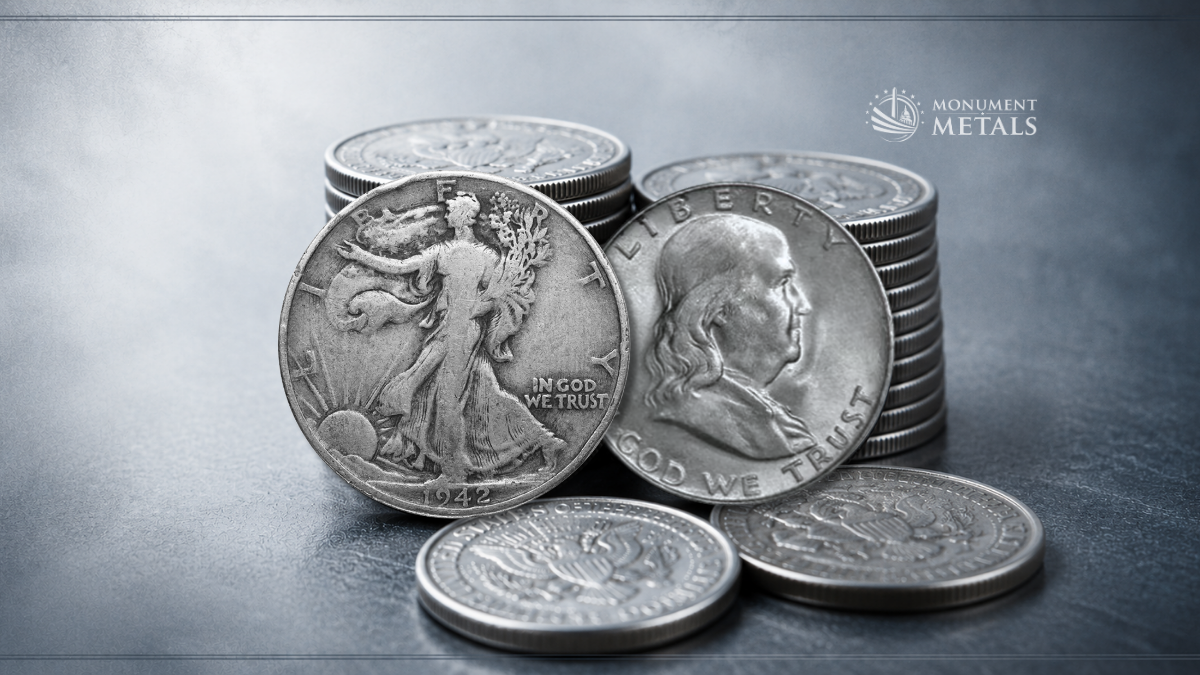
Walking Liberty half dollar (1916 through 1947): Liberty walking toward a rising sun on the front. A favorite among buyers and one of the most recognized designs in the series.
Franklin half dollar (1948 through 1963): Benjamin Franklin on the front. Common in bulk bags and straightforward to identify.
Kennedy half dollar (1964 only): John F. Kennedy on the front. The 1964 version is 90% silver. Kennedy halves from 1965 through 1970 are 40% silver and are a separate category covered below. Anything 1971 and later contains no silver.
Morgan dollars (1878 through 1921) and Peace dollars (1921 through 1935) are also 90% silver but trade differently from standard junk silver because of their size, silver content per coin, and collector crossover demand. War nickels minted from 1942 through 1945 are 35% silver and also trade as a separate category. Neither silver dollars nor war nickels are typically included in standard junk silver bags.
Identifying junk silver does not require any special equipment. There are two checks that tell you everything you need to know.
.png?width=332&height=332&name=STOCK%20VAULT%20(24).png)
Any U.S. dime or quarter dated 1964 or earlier is 90% silver. Any dime or quarter dated 1965 or later contains no silver. That cutoff is absolute for those two denominations. Half dollars are slightly different.
Most people have not looked closely at a coin's date in years. If you have inherited coins, an old collection, or even a jar of change sitting around, the date is the first thing to check. A 1961 Roosevelt dime and a 2001 Roosevelt dime look nearly identical at a glance. The date is what separates a silver coin from a worthless one.
Turn the coin on its side. Modern coins have a visible copper stripe running around the edge because they are made with a copper core sandwiched between outer layers of nickel. Pre-1965 silver coins have a solid uniform edge with no stripe. No copper stripe means silver. A copper stripe means move on.
Kennedy half dollars need their own explanation because they do not follow the simple 1964 cutoff.
The 1964 Kennedy half dollar is 90% silver, same as dimes and quarters from that era. But when the government phased silver out of coinage in 1965, they did not go cold turkey on the half dollar. Kennedy halves from 1965 through 1970 were made with 40% silver before silver was eliminated entirely in 1971. So for half dollars specifically the breakdown is: 1964 and earlier is 90% silver, 1965 through 1970 is 40% silver, and 1971 onward contains no silver at all.
The 40% Kennedy halves are still worth buying for their silver content. They just carry less silver per coin and price accordingly. Most dealers sell them separately from 90% silver coins so you always know what you are getting.
This is where junk silver separates itself from most other silver products, and where the case for buying it gets interesting.
Face value is just the number printed on the coin. A dime says ten cents. A quarter says twenty-five cents. A half dollar says fifty cents. When dealers sell junk silver, they use those printed numbers as the measuring system. Instead of counting individual coins, they add up what the coins say on their face. Two half dollars add up to one dollar of face value. So do four quarters. So do ten dimes. That is a $1 face value order no matter which coins are in it.
Here is what makes that useful: every $1 of face value in 90% junk silver contains approximately 0.715 troy ounces of pure silver regardless of which coins make up that dollar. The silver content is identical across all three denominations, which is why dealers price them the same way. A $100 face value bag costs the same whether it is filled with dimes, quarters, or halves. No weighing, no calculating per coin. Agree on a face value amount and both parties know exactly how much silver is changing hands.
What You Pay Above Melt
Junk silver rarely sells at exactly melt value. Dealers add a premium to cover costs, and that premium moves with market conditions. In normal markets premiums on 90% silver coins typically run lower than almost anything else in the silver market. A newly minted Silver Eagle can carry a premium of $5 to $10 per ounce or more above spot. Junk silver trades much closer to melt. For buyers who want the most silver per dollar spent, that gap matters.
.png?width=331&height=331&name=$10%20Face%20Value%20(1).png)
Junk silver is sold in rolls, tubes, and bags measured by face value. At Monument Metals, entry points start as low as $1 face value for individual coin types like Walking Liberty or Franklin half dollars, and $5 face value tubes for dimes. From there, rolls of $10 face value are available for quarters and halves, and bags go up to $50, $100, $500, and $1,000 face value for buyers building larger positions. Most dealers sell by denomination so you know what you are receiving. The coins within a given order will vary by date and design but the silver content is consistent regardless.
Junk silver does not qualify for a self-directed precious metals IRA. IRAs require silver with a minimum purity of 99.9% and junk silver at 90% does not meet that threshold. If you are building a metals IRA, you will need modern bullion products instead. For everything outside of an IRA, junk silver is one of the most practical silver options available.
Selling junk silver is about as straightforward as buying it. Dealers price your position based on face value and the current silver spot price using the 0.715 formula. Monument Metals buys junk silver both in person at our Frederick, Maryland location and online. Condition does not affect the buyback price since these are bought for metal content.
You do not buy junk silver because it is interesting. You buy it because it gives you more silver per dollar than almost anything else on the market, in a format that is easy to price, easy to store, and easy to sell. If you have been buying silver in other forms and skipping past the 90% coins, it is worth a second look. Browse Monument Metals' selection of 90% silver coins to see current pricing and available denominations.
%20Direction%20Clean%2c%20embedded%2c%20value-driven%20%E2%80%94%20with%20subtle%20Monument%20branding%20that%20doesn%E2%80%99t%20scream%20%E2%80%9Cad%E2%80%9D%20%E2%9C%8D%EF%B8%8F%20Locked%20Language%20(Option%202%20Refined)%20Primary%20(Hero)%20Shop%20What.png?width=1170&height=300&name=%F0%9F%8E%AF%20Final%20Banner%20Concept%20(1170%20%C3%97%20172)%20Direction%20Clean%2c%20embedded%2c%20value-driven%20%E2%80%94%20with%20subtle%20Monument%20branding%20that%20doesn%E2%80%99t%20scream%20%E2%80%9Cad%E2%80%9D%20%E2%9C%8D%EF%B8%8F%20Locked%20Language%20(Option%202%20Refined)%20Primary%20(Hero)%20Shop%20What.png)

Check the date and the edge. Any U.S. dime or quarter dated 1964 or earlier is 90% silver. For half dollars, 1964 and earlier is 90% silver and 1965 through 1970 is 40% silver. On the edge of the coin, a solid uniform color with no copper stripe means silver. A visible copper stripe means the coin contains no silver.
Because there are no minting or refining costs built into the price. These coins were produced decades ago by the U.S. government for use as currency. Dealers buy and resell them based on their silver content alone. Modern bullion coins come with production costs that get passed along to the buyer. Junk silver does not.
A silver dime contains 0.0715 troy ounces of silver. A silver quarter contains 0.1808 troy ounces. A 90% silver half dollar contains 0.3617 troy ounces. Multiply any of those figures by the current silver spot price to get the approximate melt value of a single coin.
No. Self-directed precious metals IRAs require a minimum silver purity of 99.9%. Junk silver at 90% purity does not qualify. If you are building a metals IRA, you will need modern bullion products that meet the purity requirement. Monument Metals' IRA program covers eligible options if you want to explore that route.
No. Cleaning removes the natural patina that forms on silver over time and can actually raise authenticity questions when you go to sell. Dealers buying junk silver for bullion value do not care about appearance. Leave the coins as they are.
.png?width=1200&height=675&name=Lincoln%20Memorial%20Rounds%20(2).png)