
.png?width=1200&height=675&name=Silver%20Bullion%20(2).png)
Silver Supply
Market Insights
Precious Metals History
%20(10).png?width=1200&height=675&name=NO%20TEXT%20Official%20Blog%20Banners%20(1200%20x%20675%20px)%20(10).png)

Animals appear on bullion coins because they communicate national identity instantly, without words, across any language barrier. A kangaroo tells you the coin is Australian before you read a single letter. A bald eagle places a coin squarely in American hands. A springbok marks South African origin. Governments figured out early that native animals carry a kind of universal recognition that no text or abstract design can match, and that recognition has direct value in a global market where trust and authenticity matter.
The use of animals on coinage isn't a modern marketing decision. It goes back to ancient Greece, where city-states stamped their coins with local symbols as a mark of authenticity. Athens used an owl. Corinth used a winged horse. These weren't decorative choices. They were identifiers, telling anyone who handled the coin exactly where it came from and who stood behind it.
That logic has carried forward for thousands of years. The animal on a modern bullion coin serves the same fundamental purpose it served in ancient times: it identifies the issuing authority at a glance and signals that what you're holding is genuine.
Animals work as coin designs for several reasons that hold up across cultures and centuries. They're universally recognizable. They carry emotional resonance. They don't require translation. And they connect a piece of metal to a specific place in a way that's immediately understood anywhere in the world.
Abstract symbols and portraits require context to interpret. A kangaroo does not.
Every government mint is effectively marketing its country's coins to a global audience of buyers and collectors. The animal on the coin becomes a stand-in for the country itself, carrying its reputation and recognition into the hands of buyers who may never visit and don't speak the language.
The South African Krugerrand, introduced in 1967, features the springbok on its reverse. The springbok is South Africa's national animal and one of the most recognized symbols of the country internationally. At its peak, the Krugerrand accounted for more than 90% of the global gold coin market. The springbok on that coin was known by investors on every continent.
The Chinese Gold Panda, first issued in 1982, features the giant panda, one of the most recognized animals on earth and a globally understood symbol of China. The coin became one of the world's most popular bullion products in part because the design itself carries cultural weight that extends far beyond the metal.
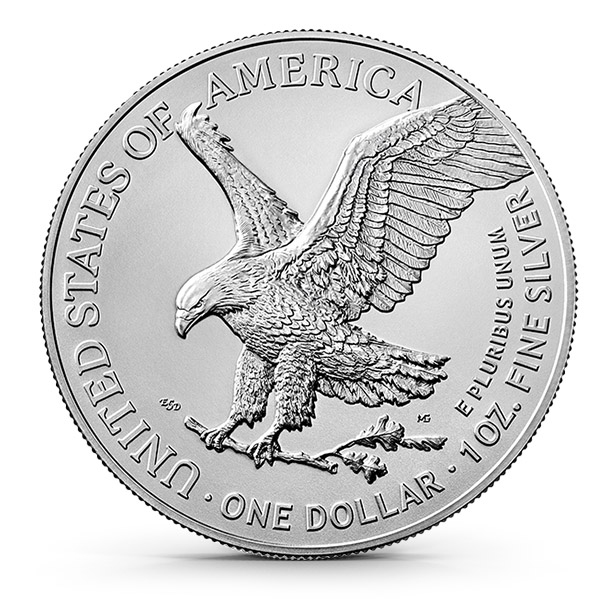
The bald eagle has appeared on American coinage and currency since the founding era. It's the national bird, a symbol embedded in U.S. iconography across generations. The American Gold Eagle and American Silver Eagle carry that symbolism forward into the modern bullion market. Every buyer who holds one, regardless of where they're from, understands what the eagle represents.
.png?width=488&height=488&name=STOCK%20VAULT%20(41).png)
The Perth Mint in Australia produces the Gold and Silver Kangaroo series, and since 1990 it has changed the kangaroo's design every single year. That decision transformed a straightforward bullion product into something with layered collector appeal.
Each year's coin is distinct. Collectors who want a complete run need every date. Buyers who simply like the design get a new version annually. The kangaroo as a constant anchor creates continuity, while the changing pose keeps the series fresh. It's a design strategy that dozens of other mints have since adopted, precisely because it works.
The Australian Kookaburra series and Koala series follow the same model. Same animal, new design each year, same result: a bullion product that generates collector demand on top of its metal value.
.png?width=496&height=496&name=STOCK%20VAULT%20(42).png)
A bullion coin with a fixed design is essentially a commodity. Two one-ounce silver coins from the same mint with the same design are interchangeable. Annual design changes break that interchangeability. Certain years become more desirable than others. Low-mintage issues develop premiums over time. The coin becomes more than its weight in metal.
That's a meaningful distinction for buyers who want their purchase to carry numismatic potential alongside intrinsic metal value.
One practical reason governments use native animals on bullion coins is authentication. A design that's instantly recognizable is also a design that's instantly verifiable. When a buyer knows what an Australian Gold Kangaroo looks like, a counterfeit with a slightly wrong kangaroo stands out. Familiar, well-documented designs are harder to fake convincingly, and easier to check.
The more globally recognized a coin design becomes, the more that recognition functions as a security feature in its own right.
A coin that dealers and buyers recognize worldwide is a coin that sells easily worldwide. Recognition drives liquidity, and liquidity is one of the most practical qualities a precious metals product can have. When you're ready to sell, you want a coin that any reputable dealer anywhere already knows, trusts, and has a price for.
The animal on the coin is doing part of that work. It identifies the coin, establishes its origin, and connects it to the sovereign guarantee behind it, all before anyone checks a weight or a purity stamp.
Knowing why mints choose the designs they do helps put your purchasing decision in context. A coin's design isn't just aesthetic. It carries the reputation of the issuing government, builds recognition that supports resale, and in some cases drives collector demand that can add value over time beyond the metal itself.
The kangaroo, the eagle, the springbok, and the panda are all doing real work. They're the reason you know exactly what you're holding the moment you see the coin.
%20Direction%20Clean%2c%20embedded%2c%20value-driven%20%E2%80%94%20with%20subtle%20Monument%20branding%20that%20doesn%E2%80%99t%20scream%20%E2%80%9Cad%E2%80%9D%20%E2%9C%8D%EF%B8%8F%20Locked%20Language%20(Option%202%20Refined)%20Primary%20(Hero)%20Shop%20What.png?width=1170&height=300&name=%F0%9F%8E%AF%20Final%20Banner%20Concept%20(1170%20%C3%97%20172)%20Direction%20Clean%2c%20embedded%2c%20value-driven%20%E2%80%94%20with%20subtle%20Monument%20branding%20that%20doesn%E2%80%99t%20scream%20%E2%80%9Cad%E2%80%9D%20%E2%9C%8D%EF%B8%8F%20Locked%20Language%20(Option%202%20Refined)%20Primary%20(Hero)%20Shop%20What.png) Frequently Asked Questions
Frequently Asked QuestionsWhy do so many gold and silver coins feature animals? Animals communicate national identity instantly across any language barrier, making them ideal for coins traded globally. They're universally recognizable, carry cultural meaning, and connect a coin to its issuing country without requiring any text. Governments have used animals on coinage for thousands of years for exactly this reason.
Which bullion coin first popularized the use of a national animal? The South African Krugerrand, introduced in 1967, is widely credited with establishing the modern bullion coin market and popularizing the use of a national animal as the central design. The springbok on its reverse became one of the most recognized coin images in the world. At its peak the Krugerrand represented over 90% of global gold coin sales.
Why does the Australian Kangaroo coin change its design every year? The Perth Mint changes the kangaroo's design annually to drive collector demand alongside bullion demand. Each year's coin is unique, which means collectors who want a complete set need every date. Certain years can develop premiums over time. The strategy has been so successful that many other mints have adopted the same annual rotation model.
Does the design on a bullion coin affect its value? For standard bullion purchases, the design matters less than the metal content. But design can add numismatic value over time, particularly for annual-design coins where certain years are struck in lower quantities. Coins with strong global recognition also tend to be more liquid, meaning they're easier to sell quickly at fair prices.
What is the most recognized animal on a bullion coin? The bald eagle on U.S. Mint coins and the giant panda on Chinese Gold Panda coins are among the most recognized globally. The Australian kangaroo and South African springbok are also well known internationally. Recognition varies by region and buyer background, but all four are instantly identifiable to most precious metals dealers worldwide.

%20copy.webp?width=1200&height=675&name=What%20Is%20the%20Difference%20Between%20a%20Coin%E2%80%99s%20Mintage%20and%20Its%20Available%20Supply%20%20(1)%20copy.webp)