
.png?width=1200&height=675&name=Silver%20Bullion%20(2).png)
Silver Supply
Market Insights
Precious Metals History
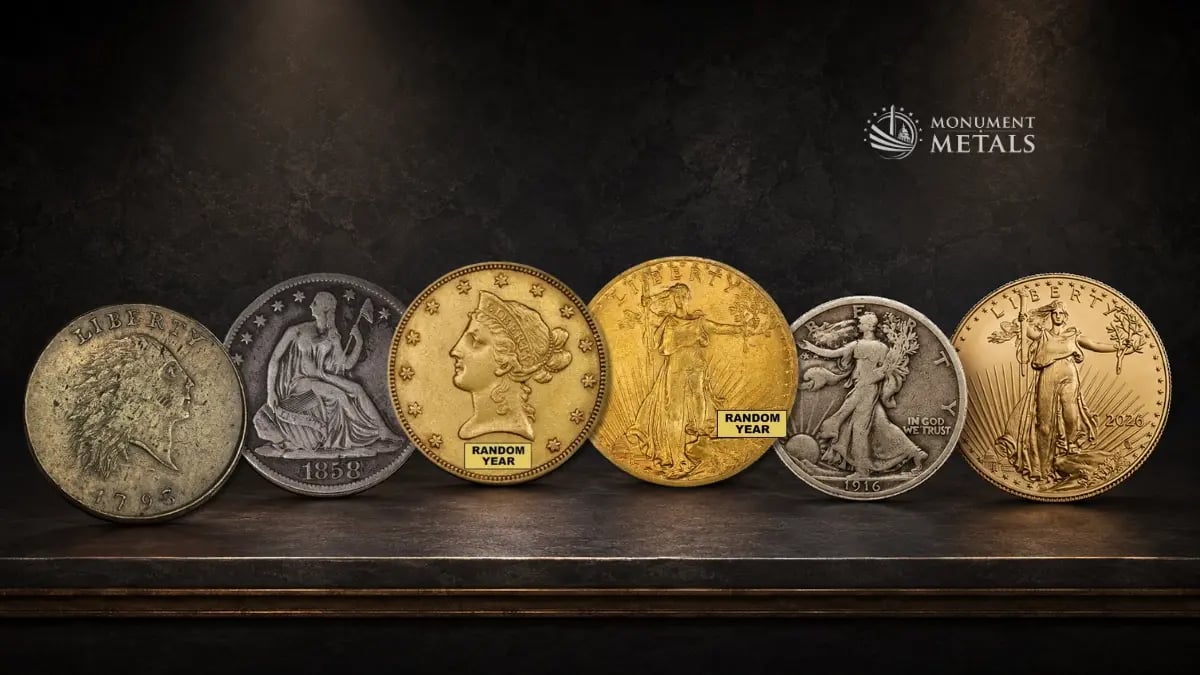


A 1793 copper cent, a Walking Liberty Half Dollar, and a modern American Eagle look like they belong to different eras.
They do. But each carries a version of the same central figure: Lady Liberty.
She is not one historical woman whose portrait was repeatedly placed on American money. Lady Liberty is an allegorical figure, meaning an artistic personification of an idea. In this case, that idea is liberty itself.

Artists use allegorical figures to give human form to ideas that cannot otherwise be pictured. Justice may hold scales. Victory may wear a wreath. Liberty may carry a torch, shield, or olive branch.
That is why Lady Liberty can look different from one coin to another. She represents a principle, not one fixed person whose portrait had to remain consistent. The U.S. Mint’s history of Liberty on coins traces that figure from early classical portraits to more active, distinctly American designs.
Artists may have worked from individual models when creating particular coins. That does not make those models the historical identity of Lady Liberty.
This also means that not every woman on a U.S. coin is Liberty. Susan B. Anthony, Sacagawea, Helen Keller, Maya Angelou, and other identifiable women are real historical people.
The choice began with the Coinage Act of 1792.
According to the U.S. Mint’s history of circulating coins, the law required every coin to carry an “impression emblematic of liberty,” the inscription “LIBERTY,” and its year of coinage on the obverse. The obverse generally means the front or heads side.
The law called for an emblem of liberty, but it did not prescribe one standardized woman, face, or pose.
Congress had considered placing George Washington and later presidents on the nation’s coins. Many believed that portraying a current president would too closely resemble Great Britain’s practice of placing monarchs on its money.
The alternative was a principle rather than a ruler.
Liberty gave the new United States a way to place one of its founding ideals directly on its coins.
The United States did not invent the idea of showing liberty as a woman.
In Greek and Roman art, artists regularly represented abstract ideas as human figures. This tradition remained familiar through statues, paintings, medals, engravings, and political imagery.
The U.S. Mint explains that a revival of interest in ancient Greece and Rome helped shape early American Liberty. She often appeared with classical facial features, gowns, sandals, and symbols.
The figure was familiar enough to communicate an idea quickly. Viewers did not need to know her as a particular person. Her pose and symbols carried the message.
The earliest circulating coins delivered by the U.S. Mint in 1793 featured Flowing Hair Liberty. Her loose hair gave the young nation an early visual language for freedom.
Later, Seated Liberty placed the figure beside a Union Shield. The classical woman remained, but the shield connected her more directly to the United States.
By the early 20th century, Liberty was no longer limited to a portrait or seated pose. Adolph A. Weinman’s Walking Liberty moved toward a rising sun while carrying oak and laurel branches. Augustus Saint-Gaudens showed Liberty advancing with a torch and olive branch.
Collectors can still find Weinman’s design on Walking Liberty Half Dollars, while other historic Liberty portraits appear on surviving pre-1933 coins such as $10 Liberty Gold Eagles.
These figures do not share the same face, clothing, pose, or group of symbols.
What they share is the idea they were created to represent.
Lady Liberty eventually disappeared from regular circulating coinage as presidents and other historical figures took her place.
But the strongest Liberty designs never disappeared from American coin art.
When the American Eagle program launched in 1986, the U.S. Mint revived two historic designs. The American Silver Eagle uses Weinman’s Walking Liberty, first introduced on the half dollar in 1916.
The American Gold Eagle uses a version of Saint-Gaudens’ standing Liberty from the 1907 $20 Double Eagle. She faces forward with a torch in one hand and an olive branch in the other.
The original coins circulated as money. Modern American Eagles are bullion coins produced primarily for their precious metal content, although collector versions are also issued.
The purpose changed. The connection to American coin history remained.
Liberty’s symbols help explain what a design is trying to communicate.
The U.S. Mint’s guide to symbols on American coins identifies the liberty cap as a symbol of freedom, with roots in an ancient Roman cap associated with emancipation. A shield can represent national unity and defense. The olive branch is associated with peace.
A torch may represent liberty, enlightenment, or a guiding light, depending on the design. The rising sun behind Walking Liberty suggests the dawn of a new day, while oak branches commonly suggest strength.
These meanings are not rigid formulas. Artists combine symbols, movement, clothing, and setting to shape each interpretation of Liberty.
Money does more than state a denomination. It can also communicate what a country values, as the Smithsonian’s examination of political messages on money demonstrates.
For the early United States, Lady Liberty offered a way to place a founding principle on the nation’s money without portraying a ruler.
Her appearance changed.
The idea endured.
That continuity explains why a figure first used on early circulating coins remains immediately recognizable on modern American bullion.
See how this historic design tradition continues today by exploring American Gold Eagles and American Silver Eagles at Monument Metals.
Is Lady Liberty based on a real person? Lady Liberty is an allegorical figure representing liberty, although artists may have used individual models while creating particular designs.
Why did early American coins feature Liberty instead of presidents? Congress chose an emblem of liberty after many people argued that portraying current presidents would too closely resemble Britain’s use of monarchs on coins.
What was the first U.S. coin to feature Lady Liberty? The first circulating coins delivered by the U.S. Mint were 1793 Flowing Hair Chain cents featuring Liberty, although earlier federal coins and patterns require separate historical definitions.
Why does Lady Liberty look different on different coins? Each artist created a new interpretation of liberty using different faces, poses, clothing, and symbols.
Is the woman on the American Silver Eagle Lady Liberty? Yes. The American Silver Eagle uses Adolph A. Weinman’s Walking Liberty design, first introduced on the Walking Liberty Half Dollar in 1916.
Who designed the Liberty on the American Gold Eagle? Augustus Saint-Gaudens created the Liberty design first used on the 1907 $20 Double Eagle and later adapted for the American Gold Eagle.

%20copy.webp?width=1200&height=675&name=What%20Is%20the%20Difference%20Between%20a%20Coin%E2%80%99s%20Mintage%20and%20Its%20Available%20Supply%20%20(1)%20copy.webp)