.png?width=1200&height=675&name=Lincoln%20Memorial%20Rounds%20(2).png)
Silver
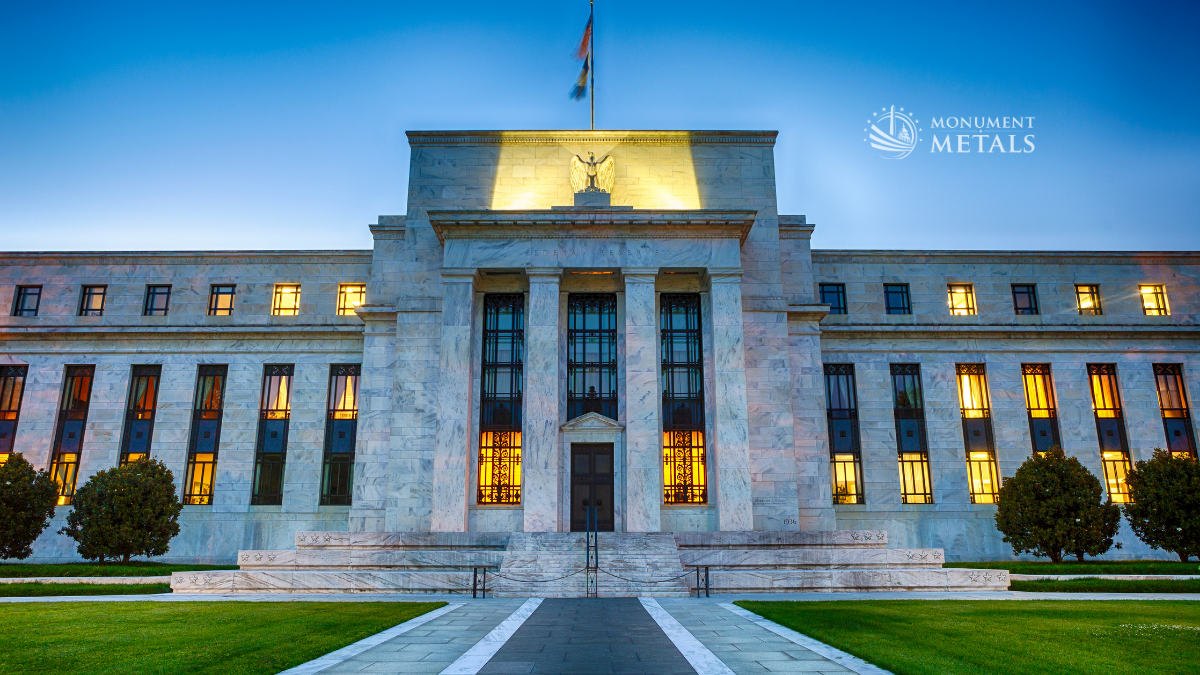

Eight times a year, financial markets stop and wait.
Not for earnings reports. Not for elections. For a statement from a committee of twelve people deciding what to do with interest rates.
The reason markets react so strongly to Federal Reserve decisions is simple: the Fed controls the price of borrowing money. And the price of borrowing money touches nearly everything else. Stocks, bonds, mortgages, the dollar, gold, silver. When the Fed moves, the ripple goes wide.
Here is what that actually means and why it matters for anyone holding or considering precious metals.
Most people know the Federal Reserve sets interest rates. Fewer people know why, or what it is balancing when it does.
Congress gave the Fed two jobs. Keep inflation stable. Keep unemployment low. Those two goals sound simple. In practice, they pull in opposite directions almost constantly.
When inflation is running hot, the Fed raises rates. Higher borrowing costs slow spending and investment, which cools prices. When the economy is slowing and jobs are disappearing, the Fed cuts rates. Cheaper borrowing encourages businesses to hire and consumers to spend.
.png?width=370&height=370&name=STOCK%20VAULT%20(54).png)
Every rate decision is the Fed trying to walk that line. Too aggressive in one direction and it either crushes growth or lets inflation run. That tension is exactly why markets watch every word the Fed says.
The Fed's primary tool is the federal funds rate: the interest rate banks charge each other for overnight loans.
That rate does not directly set mortgage rates or car loan rates or credit card rates. But it influences all of them. When the federal funds rate rises, borrowing costs throughout the entire economy follow. When it falls, they fall with it.
One number. Twelve people. The entire cost of money in motion.
When the Fed raises rates, companies pay more to borrow. Higher borrowing costs compress profits. Stock prices tend to fall in response.
At the same time, newly issued bonds start paying higher yields. That pulls money out of stocks and into fixed income. Both forces work against equity markets at once.
When the Fed cuts, the opposite happens. Borrowing gets cheaper, corporate earnings tend to expand, and money flows back toward stocks. Bonds issued before the cut become less competitive relative to new ones.
The speed of the reaction is what surprises most people. A rate decision at 2:00 PM can move markets measurably by 2:01. That is not overreaction. That is markets repricing expectations in real time.
Higher U.S. interest rates make dollar-denominated investments more attractive to foreign buyers. That increased demand pushes the dollar's value up relative to other currencies.
A stronger dollar matters for precious metals specifically. Gold and silver are priced in dollars globally. When the dollar strengthens, those metals become more expensive for buyers in other currencies. Demand softens. Prices tend to follow.
This is one of the cleaner, more consistent relationships in financial markets. A rising dollar and falling gold prices tend to show up together.
.png?width=406&height=406&name=STOCK%20VAULT%20(52).png)
Gold does not pay interest. It does not pay dividends. It simply sits there and holds value.
When interest rates are high, that creates what investors call an opportunity cost. Money sitting in gold could instead be sitting in a Treasury bond earning 4% or 5%. The higher rates go, the stronger that argument becomes.
This is why gold often faces pressure during Fed rate-hiking cycles. It is not that gold becomes less valuable. It is that higher rates make the competition more attractive on a short-term basis.
When rates fall, that opportunity cost shrinks. The argument for holding gold gets stronger. Historically, the most significant gold bull markets have coincided with falling rate environments.
Buyers of physical metal thinking in years rather than weeks should understand this relationship. It explains a lot of the short-term movement that can otherwise look random.
The Federal Open Market Committee meets eight times per year. After each meeting it releases a statement, holds a press conference, and publishes updated economic projections. Wall Street analysts dissect all of it within minutes.
The scrutiny is not theater. The Fed's words are policy. When officials describe inflation as "persistent" instead of "elevated," or call their stance "patient" instead of "data-dependent," those word choices signal what they are likely to do next. Markets price in expectations before decisions are made, which means language that shapes those expectations moves prices just as actual rate changes do.
Two words show up in almost every piece of Fed coverage.
Hawkish means an official leans toward raising rates or keeping them high to fight inflation. Dovish means they lean toward cutting rates to support growth and employment.
When the Fed signals a hawkish outlook, markets price in tighter conditions ahead. When it signals dovish, markets anticipate looser ones. A single speech from the Fed Chair can shift market expectations meaningfully in either direction without a rate change ever occurring.
Every quarter, Fed officials submit projections showing where they expect the federal funds rate to be over the next several years. These projections are displayed on a chart as dots, one per official, clustered by year. That chart is called the dot plot.
It is not a commitment. Officials change their views. But when the dot plot shifts from one quarter to the next, it tells markets which direction the committee is collectively leaning. Those shifts move asset prices before any vote is taken.
Fed policy is not abstract for most households. When rates go up, mortgage payments go up. Car loans get more expensive. Credit card rates climb. Variable-rate debt of any kind gets heavier.
On the other side, savings account yields rise. CDs pay more. For people who are net savers rather than net borrowers, a high-rate environment is one of the few times cash sitting in a bank account actually earns something meaningful.
The Fed's decisions land in household budgets long before they show up in anyone's investment portfolio.
For people who hold physical gold and silver, Fed policy is important context rather than a trading signal.
A rate-hiking cycle creates short-term headwinds for precious metals. A shift toward cuts tends to create tailwinds. But gold has risen during rate-hiking cycles before, when inflation fears or geopolitical uncertainty were strong enough to override the opportunity cost argument. The relationship is real and worth understanding. It is not mechanical.
.png?width=419&height=419&name=STOCK%20VAULT%20(53).png)
What matters for long-term holders is whether the underlying reasons to own physical metal have changed. The Fed meeting that moves gold today is rarely the thing that determines where gold is five years from now.
Why does the Federal Reserve raise interest rates? The Fed raises rates to slow inflation. Higher borrowing costs reduce spending and investment across the economy, which eases price pressure. The Fed targets an inflation rate of approximately 2% over the long term and uses rate hikes as its primary tool when inflation runs above that level.
What is the federal funds rate? The federal funds rate is the interest rate banks charge each other for overnight loans. It is set by the Federal Open Market Committee and serves as the baseline that influences borrowing costs throughout the economy, from mortgages to business loans to credit cards.
How does the Federal Reserve affect gold prices? The Fed affects gold through two main channels: interest rates and the dollar. When rates rise, the opportunity cost of holding non-yielding gold increases, which tends to weigh on prices. When the dollar strengthens alongside rate hikes, gold faces additional pressure because it becomes more expensive for international buyers. Both forces tend to ease when rates fall.
What does hawkish mean when talking about the Federal Reserve? Hawkish describes a stance that favors higher interest rates to fight inflation, even at the cost of slower growth. Dovish describes the opposite: a preference for lower rates to support the economy. When the Fed signals a hawkish lean, markets price in tighter financial conditions ahead.
What is the dot plot and why do markets care about it? The dot plot is a quarterly chart showing where each Federal Open Market Committee member expects interest rates to be over the next several years. It is not a commitment, but it reveals the committee's collective direction. Shifts in the dot plot move markets because they change expectations about future rate decisions before any vote occurs.
How often does the Federal Reserve meet? The Federal Open Market Committee meets eight times per year. Each meeting concludes with a rate decision, a public statement, and a press conference. Quarterly meetings also include updated economic projections and the dot plot.