Silver
Portfolio Strategy
New to Precious Metals


The spot price of gold and silver works like a live scoreboard for a game being played on three continents at once. Banks, refiners, mining companies, investment funds, and dealers trade metal through London's over-the-counter market, where banks trade directly with each other, and New York's COMEX futures exchange, and every agreed-upon trade nudges the score. Because that game runs nearly around the clock on weekdays and pauses from Friday evening until Sunday evening, spot keeps moving overnight but holds still on weekends.
So on a Tuesday at 2 a.m., the gold price on your phone can tick up or down every few seconds. Come Saturday, that same price freezes completely. Then at 6 PM Eastern on Sunday, it starts moving again, sometimes with a jump that surprises people.
Below, we walk through how spot is set, who's behind it, how it got this way, and why that weekend pause happens. Spot is the starting point for every coin, round, or bar you buy, so understanding it makes the premium on top of spot much easier to follow. Brand new to metals? Our beginner resource center is a great companion to this post.
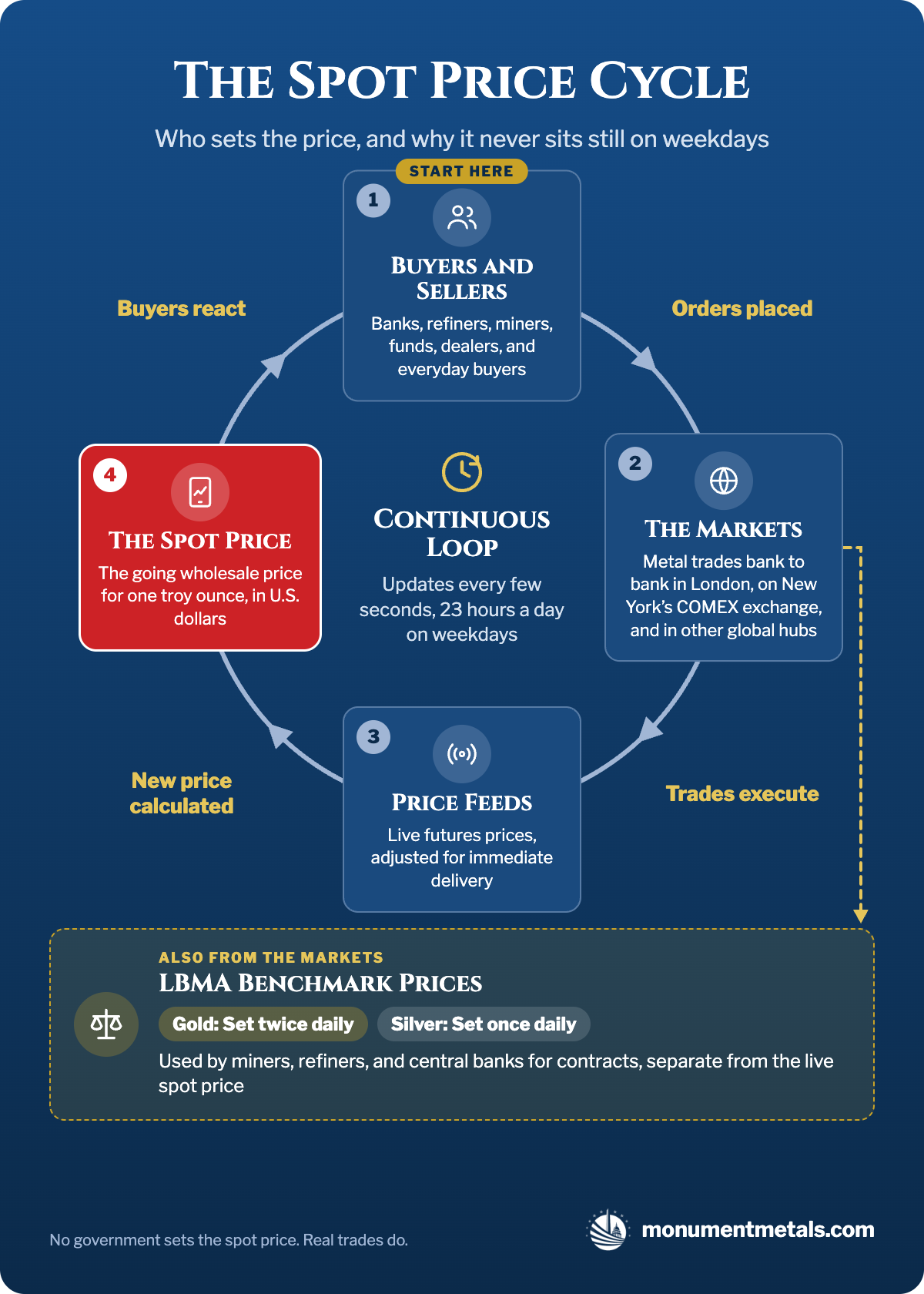
Think of spot as the going wholesale price for one troy ounce of gold or silver at this very moment. It comes straight from live trading, and here's how that number makes its way to your screen:
Traders also keep a close eye on small price gaps between markets. When gold runs a little cheaper in London than in New York, they buy where it's cheaper and sell where it's pricier, and that constant back-and-forth pulls prices back in line. That's why spot looks nearly the same no matter where in the world you check it.
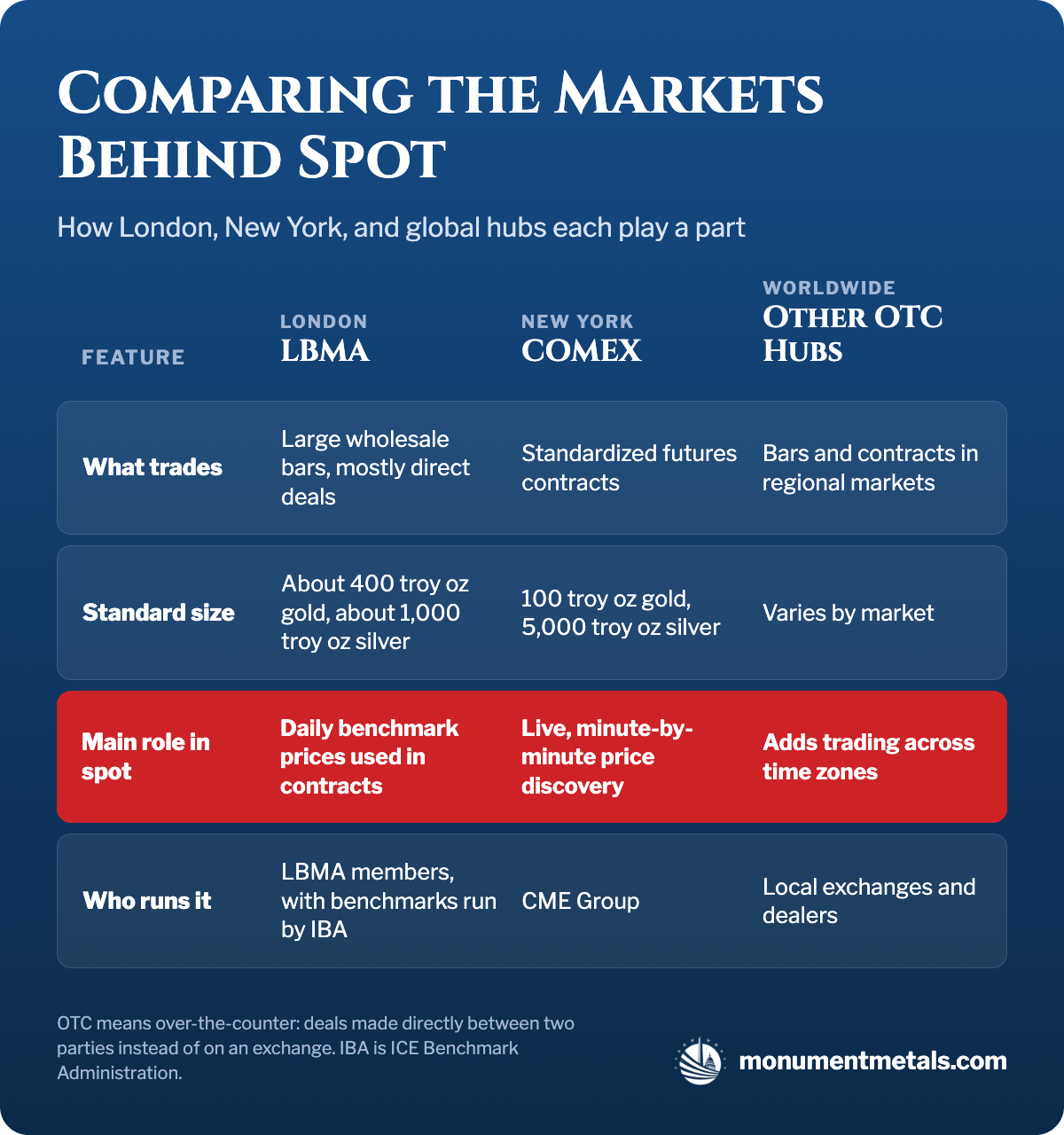
The London Bullion Market Association is the industry body for London's wholesale precious metals market, which has long been one of the largest in the world. Much of that trading happens in large bars that meet the LBMA's "Good Delivery" standard. A gold bar weighs roughly 400 troy ounces. A troy ounce is the standard unit for precious metals and is slightly heavier than a regular ounce. A silver bar weighs roughly 1,000 troy ounces.
The LBMA also publishes benchmark prices that miners, refiners, and central banks use for contracts. ICE Benchmark Administration (IBA) runs each one as an electronic auction. The gold price is set twice a day and the silver price once a day, all in U.S. dollars.
COMEX is a New York exchange owned by CME Group where gold and silver futures trade. A futures contract is an agreement to buy or sell metal at a set price on a later date. One standard gold contract covers 100 troy ounces, and one silver contract covers 5,000 troy ounces. Trading happens electronically nearly around the clock on weekdays, so COMEX is where you see most of the minute-by-minute price action.
"Over the counter" trading simply means two parties agree on a deal directly, without going through a public exchange. London's market works largely this way. Other hubs, such as Zurich, Hong Kong, and Shanghai, add their own buying and selling. Together, all these venues form the global market that spot reflects.
The buyers and sellers behind all this include bullion banks, central banks, miners and refiners, investment funds, jewelers and industrial users, plus dealers like us and buyers like you.
Each of these players responds to forces like supply and demand, the strength of the U.S. dollar, and Federal Reserve decisions. Those guides cover the "what" in more depth.
One more helpful detail: every trade has a buying side and a selling side, which is why you'll often see two prices quoted. Our guide to bid versus ask prices explains the difference.
Not even close. In ancient times, gold and silver were valued locally, and their worth compared to each other swung widely depending on who controlled the mines. London set its first official daily silver price in 1897, and gold followed in 1919. For decades after that, the U.S. dollar was tied to gold at $35 an ounce, so the price barely moved until that link ended in 1971.
From there, COMEX gold futures launched in 1974, and electronic trading arrived in 1992, eventually letting prices move nearly around the clock on weekdays. The weekend pause, though, has been there all along.
Think of the trading day as a relay race. Asia carries the baton first, London takes it next, and New York runs the final leg. Then Asia picks it up again a few hours later. While you sleep in the U.S., traders on the other side of the world are still buying and selling, so the price keeps adjusting.
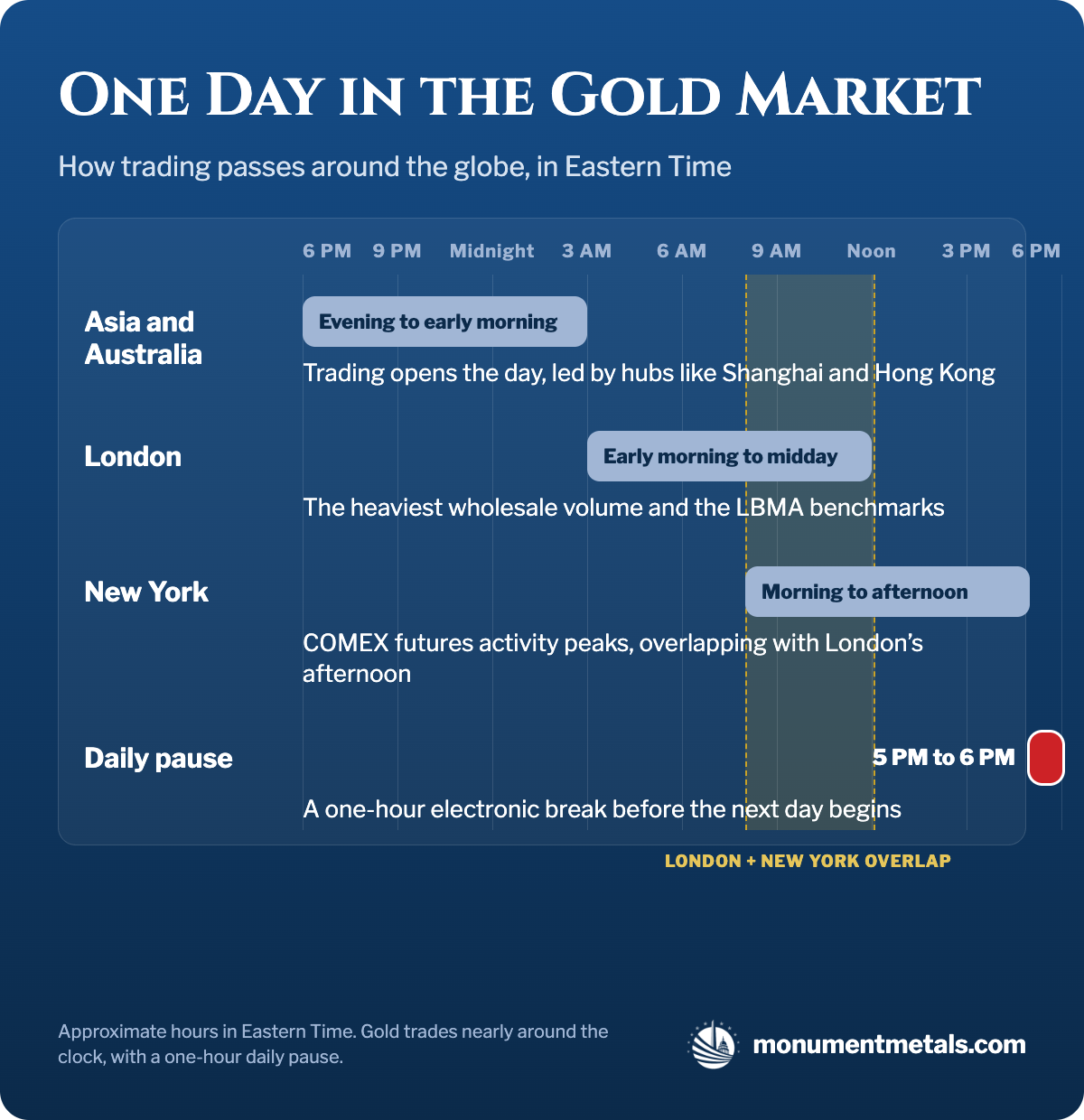
Overnight moves are often small, but news from overseas can stir things up. When that happens, our guide on buying in a fast market can help you keep a level head.
COMEX electronic trading closes Friday at 5 PM ET. Most wholesale dealers worldwide also stop quoting, because they rely on those markets to manage their risk. With no trades taking place, there's nothing to update the scoreboard. The last Friday price simply holds until trading resumes.
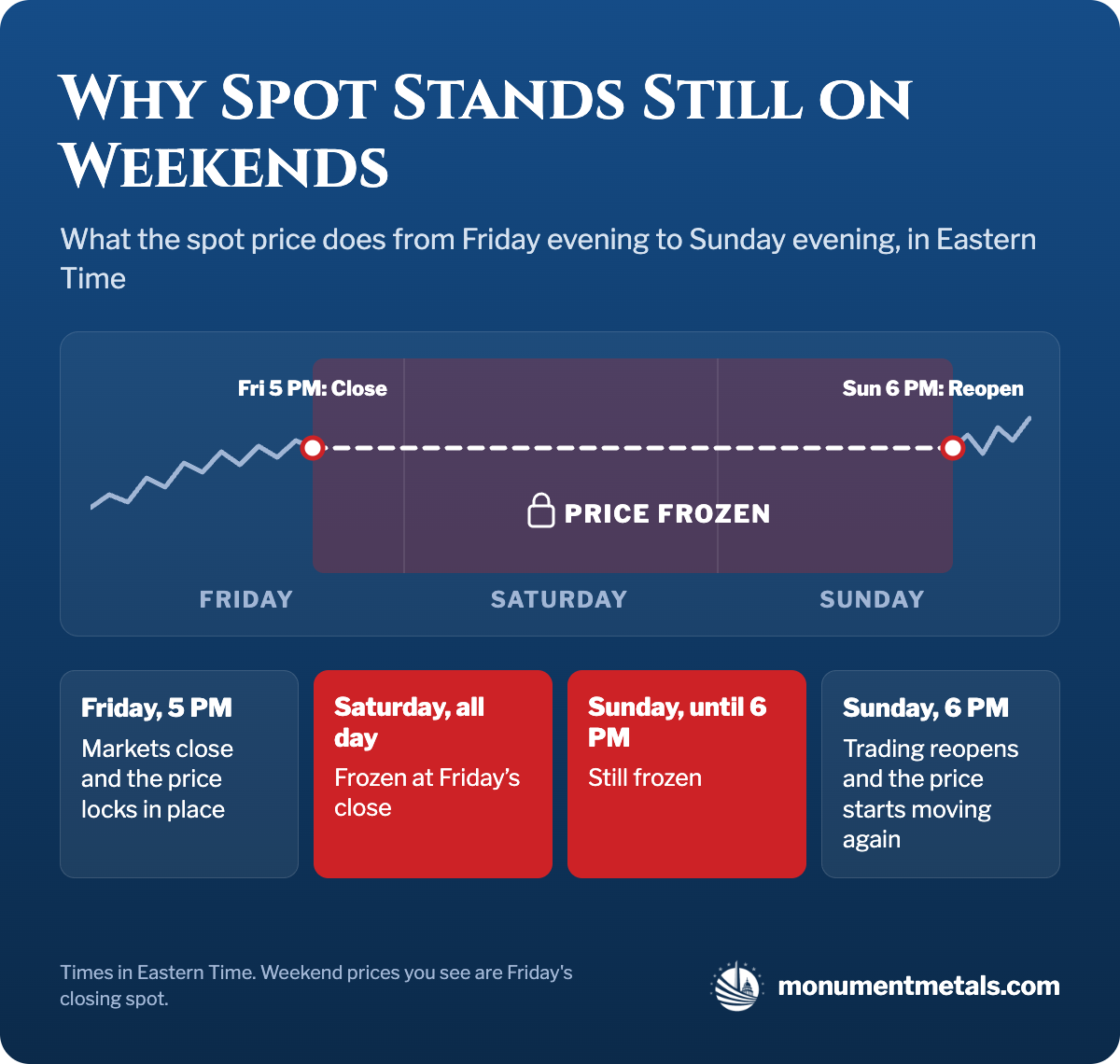
Sunday evening in the U.S. is Monday morning in Asia and Australia. The global trading week begins when those markets wake up, so the electronic exchanges reopen to meet them.
The world doesn't stop over the weekend, even though trading does. Economic headlines, policy announcements, and geopolitical events all pile up. When markets open Sunday night, buyers and sellers react to everything at once. That can cause a "gap," meaning the opening price lands noticeably higher or lower than Friday's close.
We see the weekend as a calm window for buyers. You can compare an American Gold Eagle against a 1 oz silver round, or browse our current deals, without spot shifting every few seconds. First-time buyers can also check out the Monument Starter Pack.
Just keep in mind one trade-off. Dealers normally hedge, meaning they protect themselves with offsetting trades in the futures market. They can't do that against weekend news while markets are closed. As a result, retail premiums sometimes widen slightly over the weekend compared to mid-week trading.
Ready to put this to work? Browse our selection online anytime, and enjoy free shipping on orders $199+.
Does the spot price of gold change on weekends? No. The major markets close Friday at 5 PM ET, and spot holds at that closing price until trading reopens Sunday at 6 PM ET.
What time does the gold market open on Sunday? Electronic trading on COMEX reopens at 6 PM Eastern, which is Monday morning in Asia and Australia. Holiday weeks can have different hours.
Who administers the LBMA Gold Price? ICE Benchmark Administration (IBA) runs the LBMA's gold and silver benchmarks as electronic auctions.
Why is spot quoted in troy ounces? The troy ounce is the long-standing unit for precious metals. At about 31.1 grams, it is slightly heavier than a standard ounce. Our troy ounce guide explains more.
Is the spot price what I pay for a coin or bar? Not quite. Spot is the raw metal value, and products include a premium for minting, distribution, and dealer costs. Our spot versus premium guide breaks it down.
Why does spot sometimes jump Sunday night? News keeps happening over the weekend. When trading resumes, the market reacts to all of it at once, which can open the week higher or lower than Friday's close.